Please support the Ministry’s public relations work: We need your consent to be able to measure your user activity on our website using etracker. A pseudonymised evaluation of this data by etracker helps us to improve our website. You can revoke your consent at any time for the future. Once you have made your selection, the consent management screen will appear at the bottom of the page. You can use this to stop or to reactivate the statistical evaluation at any point. You can reactivate tracking by dragging the slider in the opposite direction.
This website sets temporary session cookies. These are strictly necessary and therefore cannot be deselected. Their sole purpose is to enable you to use the website.
The Ministry also presents its work on this website in the form of videos. These are made available by the provider TV1 using JW Player. Please consent to the transmission of your IP address and other technical data to JW Player and allow JW Player to set cookies on your end device if you wish to view videos on our website. We also provide a consent management function for this at the bottom of the page. You can use this to control whether JW Player is enabled or not.
You can find detailed information on your rights and how we protect your privacy in our privacy policy.
Consent to the use of JW Player for video streaming
The Ministry also presents its work on this website in the form of videos. These are made available by the provider TV1 using JW Player. Please consent to the transmission of your IP address and other technical data to JW Player and allow JW Player to set cookies on your end device if you wish to view videos on our website. We also provide a consent management function for this at the bottom of the page. You can use this to control whether JW Player is enabled or not.
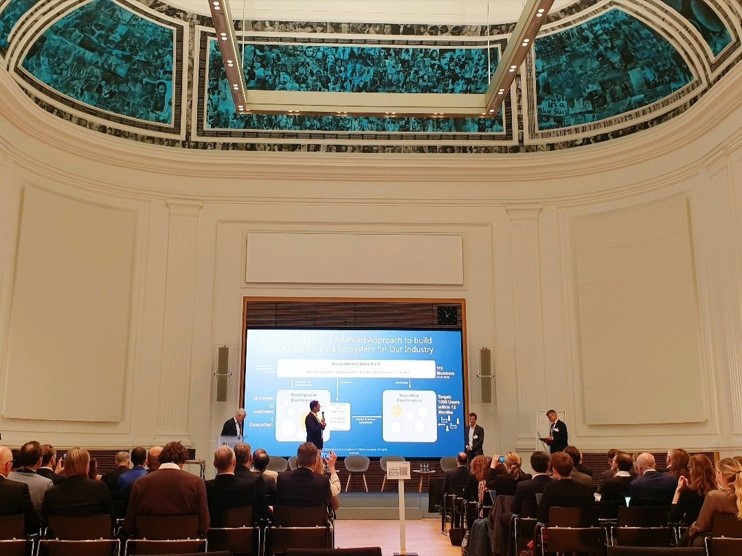
The symposium was joined by experts from the Plattform Industrie 4.0 and other experts with juridical knowledge in Berlin. Together they exchanged on the legal preconditions for industrial data spaces. In the beginning, Markus Heß, manager of the subdivision “Future of the Industry; Mobility” of the Federal Ministry for Economic Affairs and Climate Action, welcomed the participants and introduced the focus of the symposium. The main topics were collaborative data spaces, multilateral data sharing and the Data Act from the EU commission.
To dive into the vision and practice of data spaces the participants got to listen to two impulse lectures. In the first one, Peter Ittenbach and Nina Stock from the Federal Ministry for Economic Affairs and Climate Action explained the role of the initiative "Manufacturing-X" for the Industrie 4.0. How relisient and sustainable value added networks of an intelligently connected industry were paramount in the lecture. In the second one, Prof. Dr. Matthias Leistner, chair of civil law, intellectual property law, infomational law and IT-law from the LMU Munich gave profound insights in the legal challenges that the industry has to face regarding collaborative data spaces, such as regulation or information sharing.
The three breakout sessions within the symposium were greeted with special excitement and engagement. These offered the participants to discuss legal issues concerning data spaces that come with practical implementation. The session "Legal Testbed" shed light on the chances and challenges that come with autmated contract negotiations. In a progress report on the the topic "Catena-X" the participants gained insights to the potential of building an ecosystem for collaborative data use can offer. The third breakout session was dedicated to Collaborative Condition Monitoring (CCM). The use case CCM makes it possible to discuss the legal framework conditions for data ecosystems on a vivid example.
The final highlight of the symposium was the panel discussion “Fight for Data – is innovative regulation the solution for company driven collaboration?”, during which the five experts and the moderators Dr. Romina Polley and Cleary Gottlieb explained their perspectives:
Andreas Hartl, head of division “Strategy Artificial Intelligence, Data Economy, Blockchain” of the Federal Ministry of Economic Affairs and Climate Action
Dr. Michael Dose, speaker for digitalization and innocation at BDI
The speakers discussed the latest legal developments of the “Data Act”, one of the big building blocks of the European data strategy. The main points of the Data Act are among others the regulations that should stop third countries from retrieving personal data from the EU while infinging national or European law. Here you can find additional background on the Data Act.