Please support the Ministry’s public relations work: We need your consent to be able to measure your user activity on our website using etracker. A pseudonymised evaluation of this data by etracker helps us to improve our website. You can revoke your consent at any time for the future. Once you have made your selection, the consent management screen will appear at the bottom of the page. You can use this to stop or to reactivate the statistical evaluation at any point. You can reactivate tracking by dragging the slider in the opposite direction.
This website sets temporary session cookies. These are strictly necessary and therefore cannot be deselected. Their sole purpose is to enable you to use the website.
The Ministry also presents its work on this website in the form of videos. These are made available by the provider TV1 using JW Player. Please consent to the transmission of your IP address and other technical data to JW Player and allow JW Player to set cookies on your end device if you wish to view videos on our website. We also provide a consent management function for this at the bottom of the page. You can use this to control whether JW Player is enabled or not.
You can find detailed information on your rights and how we protect your privacy in our privacy policy.
Consent to the use of JW Player for video streaming
The Ministry also presents its work on this website in the form of videos. These are made available by the provider TV1 using JW Player. Please consent to the transmission of your IP address and other technical data to JW Player and allow JW Player to set cookies on your end device if you wish to view videos on our website. We also provide a consent management function for this at the bottom of the page. You can use this to control whether JW Player is enabled or not.
Digitising with China - German and Chinese experts discuss digitisation and AI in industry
Introduction
On 25 April 2018, the Federal Ministry for Economic Affairs and Energy (BMWi) hosted the event “Digitising with China” at Hanover Fair. Mr Ernst Stöckl-Pukall, Division Director for Digitisation and Industrie 4.0 at BMWi, opened the conference together with Mr YIN Jun, Minister Counsellor from the Embassy of China in Germany. Over 130 German and Chinese representatives from government, industry and academia discussed the most recent developments of digitisation and application of Artificial Intelligence (AI) in the Chinese manufacturing sector.
Organised by the Deutsche Gesellschaft für Internationale Zusammenarbeit (GIZ), the event featured various presentations, panel discussions and use cases, including keynotes from Dr Oliver Blank, Director for European and China Affairs at ZVEI, Dr Jens Gayko, Managing Director of the Standardisation Council Industrie 4.0 as well as Prof Dr Martin Ruskowski, Head of Innovative Factory Systems of the German Research Center for Artifical Intelligence. The China Centre for Information Industry Development (CCID) provided an overview of the Sino-German cooperation in the field of Intelligent Manufacturing, including an insider perspective on the latest developments of “Made in China 2025” by Mr WANG Peng, Vice President of CCID. Experts from HUAWEI and Yunji Technology presented on successful cases of AI application in China (the Chinese Initiative "Made in China 2025" is the counterpart of the German Plattform Industrie 4.0).
Among the most notable highlights of “Digitising with China” were two thought-provoking panel discussions: During the session “Artificial Intelligence - Driver for Intelligent Manufacturing”, experts from academia and the private sector discussed the status quo of AI research and its application in Germany and China as well as their expectations for future AI developments in the manufacturing sector. Panellists agreed that deeper Sino-German cooperation would be beneficial to further explore the potentials of AI for Intelligent Manufacturing processes. During the panel “Sino-German Cooperation: Short-term Benefit or Long-term Partnership?”, experts discussed whether a sustainable Sino-German partnership could be attained and how it could go beyond short-term commercial benefits. Panellists from both countries expressed confidence that a strategic long-term partnership is both attainable and desirable. The discussions centred on market openness and the facilitation for fair competition, which were deemed essential for realising a reciprocal long-term partnership between Germany and China.
About the Sino-German Industrie 4.0 Project
Based on the Memorandum of Understanding (MoU) between the Federal Ministry for Economic Affairs and Energy (BMWi) and the Chinese Ministry of Industry and Information Technology (MIIT) signed in 2015, the Sino-German Industrie 4.0 cooperation aims to improve the business environment and facilitate bilateral cooperation between German and Chinese companies. The China Centre for Information Industry Development supports MIIT in this cooperation. On the German side, BMWi has commissioned the Deutsche Gesellschaft für Internationale Zusammenarbeit to support the implementation of the MoU.
Conference "Digitising with China"
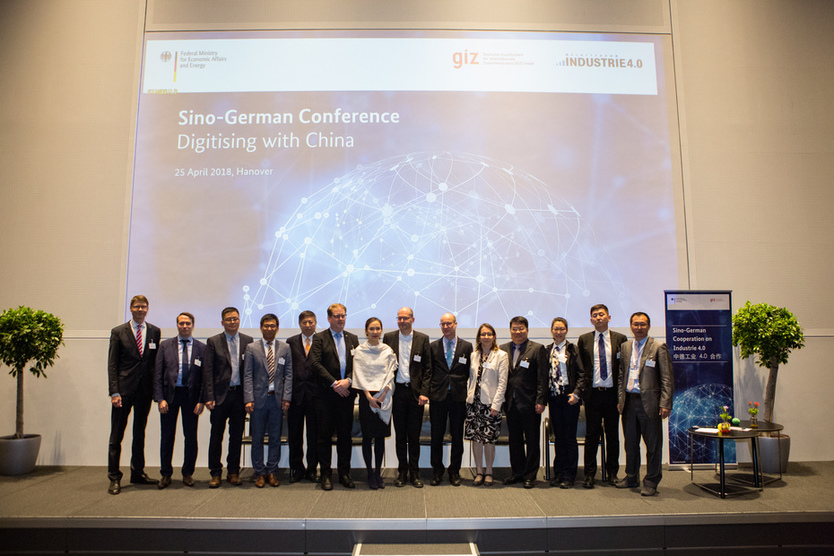
The participants of the conference "Digitising with China" at the Hanover Fair
Panel with (left to right): Dr. Oliver Blank, Director European and China Affairs, ZVEI; Mr CHENG Ji, CEO, Alibaba Cloud Germany; Mr Ernst Stöckl-Pukall, Division Direc-tor, Division for Digitisation, Industrie 4.0, German Federal Ministry for Economic Affairs and Energy; Mr WANG Peng, Vice President, China Center for Information Industry Development (CCID); Mr SHU Jinlong, Chairman, CASICloud; Mr Jost Wübbeke, Senior Analyst, Sinolytics