Please support the Ministry’s public relations work: We need your consent to be able to measure your user activity on our website using etracker. A pseudonymised evaluation of this data by etracker helps us to improve our website. You can revoke your consent at any time for the future. Once you have made your selection, the consent management screen will appear at the bottom of the page. You can use this to stop or to reactivate the statistical evaluation at any point. You can reactivate tracking by dragging the slider in the opposite direction.
This website sets temporary session cookies. These are strictly necessary and therefore cannot be deselected. Their sole purpose is to enable you to use the website.
The Ministry also presents its work on this website in the form of videos. These are made available by the provider TV1 using JW Player. Please consent to the transmission of your IP address and other technical data to JW Player and allow JW Player to set cookies on your end device if you wish to view videos on our website. We also provide a consent management function for this at the bottom of the page. You can use this to control whether JW Player is enabled or not.
You can find detailed information on your rights and how we protect your privacy in our privacy policy.
Consent to the use of JW Player for video streaming
The Ministry also presents its work on this website in the form of videos. These are made available by the provider TV1 using JW Player. Please consent to the transmission of your IP address and other technical data to JW Player and allow JW Player to set cookies on your end device if you wish to view videos on our website. We also provide a consent management function for this at the bottom of the page. You can use this to control whether JW Player is enabled or not.
Working Group “Security of Collaborative Ecosystems”
Introduction
The working group develops solutions, recommendations for action and concrete application examples for a secure, networked industry. IT security should be anchored as a central key factor of global value chains in international standards, but also in the awareness and competence portfolio of companies.
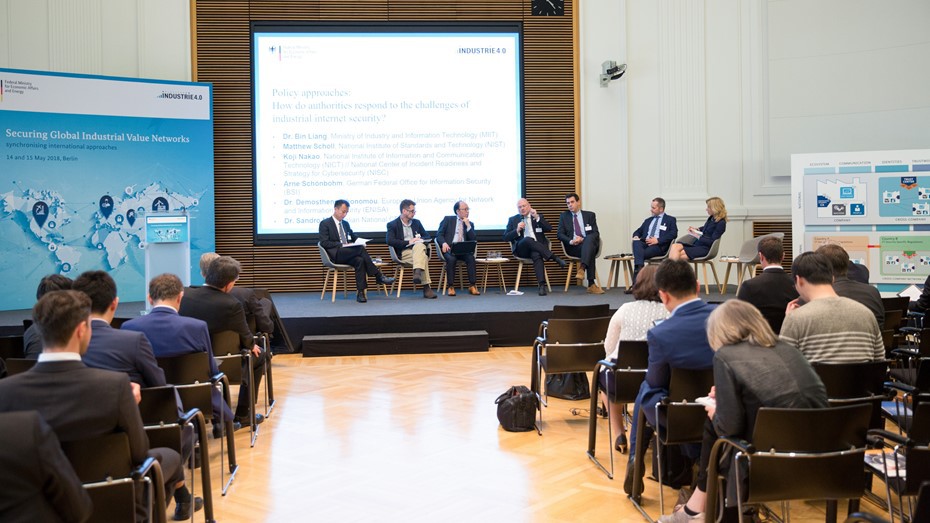
Michael Jochem, Head of the Working Group "Security of Networked Systems" at the conference "Securing Global Industrial Value Networks - Synchronizing International Approaches" in 2018 in Berlin
Challenge and mission: Security as an enabler for Industrie 4.0
Producers, suppliers and customers from all over the world exchange their data in networked production. The central prerequisite for this is trust—only those who know their data to be in good hands with partners pass it on. This makes IT security a pioneer of Industrie 4.0 and an important mark of quality in companies. After all, companies that apply verifiable IT security measures are trustworthy and become sought-after partners in digital networks.
IT security must therefore have a firm place in the consciousness of those responsible, in the qualifications of employees and in international standards. This working group supports this process with solutions, recommendations for action and concrete application examples for a secure, networked industry.
Outcome 1: Appropriate solutions for global challenges
The working group “Security of Collaborative Ecosystems” works on several core topics of IT security, which are closely interlinked:
Secure communication: In a networked industry, systems, machines and products should always interact and exchange data. But this only works if technical communication mechanisms ensure that Industrie 4.0 components can make secure contact. This working group is thinking through the technical requirements for secure communication.
Identification and Authentication: For secure data exchange, it must be clear that the sender and recipient of data are the ones they claim to be and that they have the right to send and receive the information. This working group provides an overview of the essential requirements for secure identities and develops recommendations for action for politics and industry.
Integrity and trustworthiness: Digitalization and networking require trust in the correctness of your own data and external data. This working group investigates how correctness, unalterability and completeness (= integrity) of data, systems and processes can be provided and checked.
The security requirements formulated by the working group are to be anchored in the basic architecture of Industrie 4.0. That is why the working group works closely together with the working group "Reference Architectures and Standards". For example, security requirements for the administration shell were worked out together and the extent to which communication with the OPC UA standard can be securely communicated was analyzed.
Outcome 2: The working group brings together global key players
In May 2018, the working group together with the Federal Ministry for Economic Affairs and Energy implemented the international conference "Securing Global Industrial Value Networks - Synchronizing International Approaches". About 140 international decision-makers from business and politics accepted the invitation and discussed IT security issues in Berlin. The conference was about technical aspects and appropriate political regulation. The discussion was based on the concepts of the working group "Security of Collaborative Ecosystems”".
The contributions and debates revealed starting points for a common approach. The working group and its international partners therefore agreed to answer open questions together after the conference and to work out ideas for technical and regulatory solutions.
Objective: to anchor security as a quality feature
The working group will build on these results and deepen their work on technical issues. At the same time, the "soft" factors should also come to the fore: what does a corporate organization that is just for security look like? And what qualifications do employees need to protect company data? Work on standards is also to be continued: A demonstrator for the secure use of OPC UA should be developed. Safety requirements developed by the working group should feed into (inter-)national standardization processes and research plans. The overall goal remains: anchoring security as a quality feature.
Structure and working methods: intensive work on a wide range of topics
Over 40 experts work intensively in the working group. In addition, they meet in person six times a year as well as ad hoc by phone and online. Experts discuss and produce results withing six sub-working groups:
Secure identities
Secure communication for Industrie 4.0 (together with the working group “reference architectures, standards and norms”)
Standards
Organization and qualification
Roles and legal models
SG Security (ZVEI)
Learn more about Security
Article
Article:Between trust and security: New security concepts for Industrie 4.0