Please support the Ministry’s public relations work: We need your consent to be able to measure your user activity on our website using etracker. A pseudonymised evaluation of this data by etracker helps us to improve our website. You can revoke your consent at any time for the future. Once you have made your selection, the consent management screen will appear at the bottom of the page. You can use this to stop or to reactivate the statistical evaluation at any point. You can reactivate tracking by dragging the slider in the opposite direction.
This website sets temporary session cookies. These are strictly necessary and therefore cannot be deselected. Their sole purpose is to enable you to use the website.
The Ministry also presents its work on this website in the form of videos. These are made available by the provider TV1 using JW Player. Please consent to the transmission of your IP address and other technical data to JW Player and allow JW Player to set cookies on your end device if you wish to view videos on our website. We also provide a consent management function for this at the bottom of the page. You can use this to control whether JW Player is enabled or not.
You can find detailed information on your rights and how we protect your privacy in our privacy policy.
Consent to the use of JW Player for video streaming
The Ministry also presents its work on this website in the form of videos. These are made available by the provider TV1 using JW Player. Please consent to the transmission of your IP address and other technical data to JW Player and allow JW Player to set cookies on your end device if you wish to view videos on our website. We also provide a consent management function for this at the bottom of the page. You can use this to control whether JW Player is enabled or not.
Open, digital ecosystems “Made in Europe”
The Trilateral Cooperation and European Commission discuss Europe’s path to industry 4.0
Introduction
On 30 September 2020, nearly 100 experts met for the day of virtual dialogue "Smart Manufacturing after COVID-19". The initiators of the Trilateral Cooperation (France, Italy and Germany), representatives of the European Commission and participants from numerous EU member states discussed the necessary steps on Europe’s path to a digitalised manufacturing industry. The impact of COVID-19 has clearly demonstrated the advantages of digitalised, value-added networks. The common goal is open, digital ecosystems governed in accordance with European values. The partners will continue to work together closely in order to collectively “make Europe strong again”.
There was agreement among the participants on the screens: The pandemic has shown that it is now time to act. Lucilla Sioli, Director, Artificial Intelligence & Digital Industry Directorate, DG CONNECT stated: „European cooperation is key – apart from the COVID-19 crisis, there will be many more challenges that we need to and can tackle together.“ It is time to launch open and digital ecosystems in Europe and create the conditions for a competitive, resilient and sustainable path to growth for European industry. This means ensuring more flexible, resilient, resource-efficient production processes and optimised value-adding structures. Open and digital ecosystems could achieve this. Not only do they build on diversity, plurality and fair competition, they also promote it in the long term. And they make a social contribution to cushioning the COVID-19 crisis.
The path
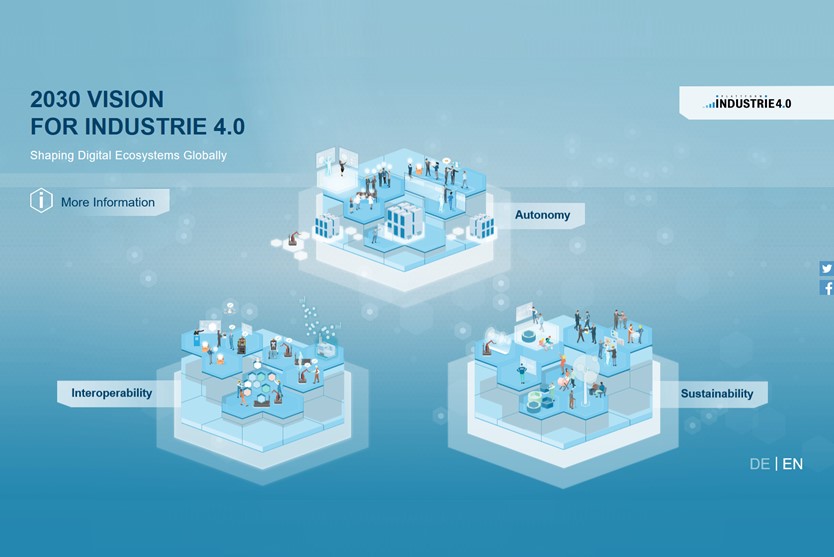
For Dr Peter Post, Vice President at Festo and member of the Steering Committee of the Industry 4.0 Platform, three lines of action are crucial on the path to open ecosystems. This is because they are closely linked to key European fundamental values: sovereignty, interoperability and sustainability.
Sovereignty stands for the requirements that must be met. In line with the 2030 vision of the Plattform Industrie 4.0, these result from a pan-European, sovereign, trustworthy, secure and resilient digital infrastructure (as defined by the GAIA-X project). Speaking about the prerequisites for using AI, Michael Jochem, Business Chief Digital Office -Industrial Technology at Bosch and head of the working group "Security of networked systems" in the Plattform Industrie 4.0, explained: "Innovative, multilateral B2B cooperation across company and competition boundaries is essential for data to be collected. We need a trustworthy infrastructure that supports data sovereignty in order to facilitate the aforementioned data exchange".
Other important requirements include training targeted at SMEs and a general cultural change. The need for cross-border cooperation and digital European competence centres, where experiences and best practices can be exchanged, was also highlighted.
Interoperability describes the need for general standards for the smooth interaction between digital components, systems and processes (administration shells and digital twins), said Dr Post. It is an essential prerequisite for avoiding lock-in effects and for giving smaller companies fair access to digital value-added networks - this is particularly important for European industry, which is characterised by small and medium-sized enterprises.
Sustainability is the common goal. Data analysis and secure B2B data exchange form the basis of a resource-efficient data economy and thus also for 4.0 applications that make the potential for sustainability measurable and sustainability goals concretely truly feasible (e.g., reducing emissions). Industry 4.0 solutions support the implementation of sustainability goals in terms of the European Green Deal.
Kilian Gross, Head of Unit, Technologies & Systems for Digitising Industry Unit, DG CONNECT summed it up: „Green economy and digitalisation are not contradictory, but reinforce each other. We need to adopt an holistic approach to digitalisation and sustainability to reach a green and competitive transformation of economy in Europe – and we need cooperation to bridge this gap quickly.“
What’s next?
We now need to create the conditions for the competitive, resilient and sustainable growth of European industry, so that Europe can become the global pioneer for open and digital ecosystems. “A resilient data economy by 2030 starts now”, said Yves Paindaveine, Head of Sector, Digitising European industry governance, DG CONNECT.
The Trilateral Cooperation invites all European partners to another meeting which will take place in early 2021 and will continue to be supported by the European Commission.
About the Trilateral Cooperation
The trilateral cooperation between Germany’s Plattform Industrie 4.0, France’s Alliance Industrie du Futur and the Italian Piano Impresa 4.0 was founded in 2017. The aim is to advance the digitalisation of manufacturing throughout the EU in the spirit of European cooperation. The partners are concentrating on three core themes: standardisation, SME support and the policy framework. They have developed a joint action plan and regularly publish joint papers, e.g. on the administration shell, data ownership and EU framework conditions.