Please support the Ministry’s public relations work: We need your consent to be able to measure your user activity on our website using etracker. A pseudonymised evaluation of this data by etracker helps us to improve our website. You can revoke your consent at any time for the future. Once you have made your selection, the consent management screen will appear at the bottom of the page. You can use this to stop or to reactivate the statistical evaluation at any point. You can reactivate tracking by dragging the slider in the opposite direction.
This website sets temporary session cookies. These are strictly necessary and therefore cannot be deselected. Their sole purpose is to enable you to use the website.
The Ministry also presents its work on this website in the form of videos. These are made available by the provider TV1 using JW Player. Please consent to the transmission of your IP address and other technical data to JW Player and allow JW Player to set cookies on your end device if you wish to view videos on our website. We also provide a consent management function for this at the bottom of the page. You can use this to control whether JW Player is enabled or not.
You can find detailed information on your rights and how we protect your privacy in our privacy policy.
Consent to the use of JW Player for video streaming
The Ministry also presents its work on this website in the form of videos. These are made available by the provider TV1 using JW Player. Please consent to the transmission of your IP address and other technical data to JW Player and allow JW Player to set cookies on your end device if you wish to view videos on our website. We also provide a consent management function for this at the bottom of the page. You can use this to control whether JW Player is enabled or not.
Plattform Industrie 4.0 launching the Networked Asset Administration Shell project
Introduction
In order for a message to be understood, a common language is needed – made up of a unified set of vocabulary, grammar rules and dialogue sequences. This is also true for the smart machines and products used in Industrie 4.0. Plattform Industrie 4.0 has now launched a flagship project funded by the Federal Ministry for Economic Affairs and Energy. The project brings together a range of existing projects implementing the Asset Administration Shell (AAS) within a virtual testing environment and harmonises the languages they use. The aim is to make different AAS interoperable.
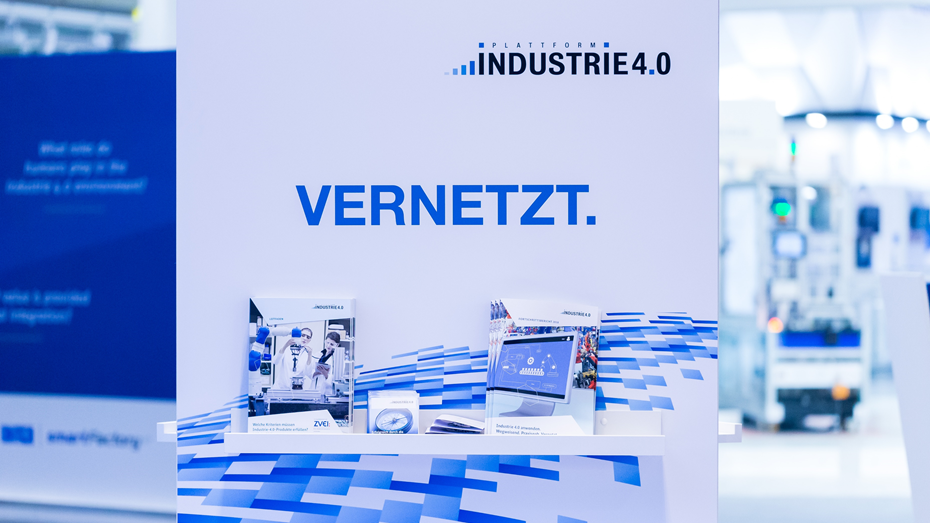
„Vernetzt“ (networked) – the newly started cross-cutting project. It shows how existing approaches fit together.
A: I’d like two pounds of that
B: Bye!
A: Yes, please
B: What would you like?
A: Good afternoon!
B: Two pounds of this?
The two interlocutors A and B in this example use dialogue sequences that only make sense if they are in the right order. Our own language shows us how important rules are in order for us to understand one another.
The same is true for the interaction between I4.0 components like machines and products. They first need a standardised language so that they can understand each other and can work and cooperate with one another across value networks both in an agile manner and in changing constellations. Through its Asset Administration Shell, Plattform Industrie 4.0 has laid the foundations for developing such a language and has created a specification that is already being used in many projects implementing the AAS.
Within the individual projects, the interaction between the various Asset Administration Shells works well. But what happens when Asset Administration Shells from different initiatives and companies are confronted with different technologies and implementation variants? Does the SAP AIN demonstrator use the same language as the BaSys4.0 project? Do they understand digitally exchanged messages correctly? And can they communicate with one another in a way that enables them to interact autonomously and complete their tasks?
Talking about the newly launched breakthrough project Networked Asset Administration Shell (Verwaltungsschale vernetzt), Mr Christian Diedrich from the Otto von Guericke University Magdeburg and ifak (Institute for Automation and Communication) says, “[these questions] are exactly what we are going to be looking at over the next two years. He then goes on to explain the project further: “We are going to bring the various individual solutions together within a virtual testbed. This will enable us to analyse the Asset Administration Shells, to assess them, and to derive the requirements to be included in the specification, including the REST interface specification, the I4.0 language and the IT infrastructure. By doing so, we will be able to test that existing approaches are interoperable. Once we have got this far, further demonstrators will then be able to test the interoperability of these approaches with these Asset Administration Shells. In this second step, users and SMEs will have the opportunity to link up their own Asset Administration Shells with the testbed to test whether they are compatible.”
The project is being funded by the Federal Ministry for Economic Affairs and Energy and realised in conjunction with the Plattform Industrie 4.0 operated the Otto von Guericke University Magdeburg.
Background:
The idea to launch the Networked Asset Administration Shell breakthrough project was originally floated at the Asset Administration Shell Conference at the end of 2017. During this conference and at the follow-up event, representatives of ten projects implementing Asset Administration Shells joined with standardisation experts from Plattform Industrie 4.0 to agree measures that could be introduced to start to make the projects interoperable. The breakthrough project was initiated by the Plattform Industrie 4.0 Working Group on Reference Architectures, Standards and Standardisation, which has asked the following initiatives and projects to take part:
BaSys4.0
IBM Cognitive Twin VIA Smart Factory DFKI
openAAS
openAAS in joint demonstrator
SAP AIN
SemAnz40 project, operated by the Federal Ministry for Economic Affairs and Energy
Smart Factory DFKI
Fraunhofer IOSB-INA Lemgo in cooperation with the leading-edgeitsOWL
Planned activities include workshops where user stories can be developed and interaction protocols tested for different scenarios. In addition to developing a software specification for the testbed and a model software source code, plug festivals are also set to be held where companies can test how the elements interact with one another. The first project meeting will take place on 14 June.
We will keep you up-to-date via the channels on the Plattform. You can also find comprehensive information on the Administration Asset Shell concept in our online library.