Please support the Ministry’s public relations work: We need your consent to be able to measure your user activity on our website using etracker. A pseudonymised evaluation of this data by etracker helps us to improve our website. You can revoke your consent at any time for the future. Once you have made your selection, the consent management screen will appear at the bottom of the page. You can use this to stop or to reactivate the statistical evaluation at any point. You can reactivate tracking by dragging the slider in the opposite direction.
This website sets temporary session cookies. These are strictly necessary and therefore cannot be deselected. Their sole purpose is to enable you to use the website.
The Ministry also presents its work on this website in the form of videos. These are made available by the provider TV1 using JW Player. Please consent to the transmission of your IP address and other technical data to JW Player and allow JW Player to set cookies on your end device if you wish to view videos on our website. We also provide a consent management function for this at the bottom of the page. You can use this to control whether JW Player is enabled or not.
You can find detailed information on your rights and how we protect your privacy in our privacy policy.
Consent to the use of JW Player for video streaming
The Ministry also presents its work on this website in the form of videos. These are made available by the provider TV1 using JW Player. Please consent to the transmission of your IP address and other technical data to JW Player and allow JW Player to set cookies on your end device if you wish to view videos on our website. We also provide a consent management function for this at the bottom of the page. You can use this to control whether JW Player is enabled or not.
Second Sino-German Annual Meeting of the State Secretaries and Vice Ministers on Intelligent Manufacturing
Intensive exchange in Beijing on the opportunities and challenges of Industrie 4.0 with over 400 German and Chinese representatives from government, industry and science
Introduction
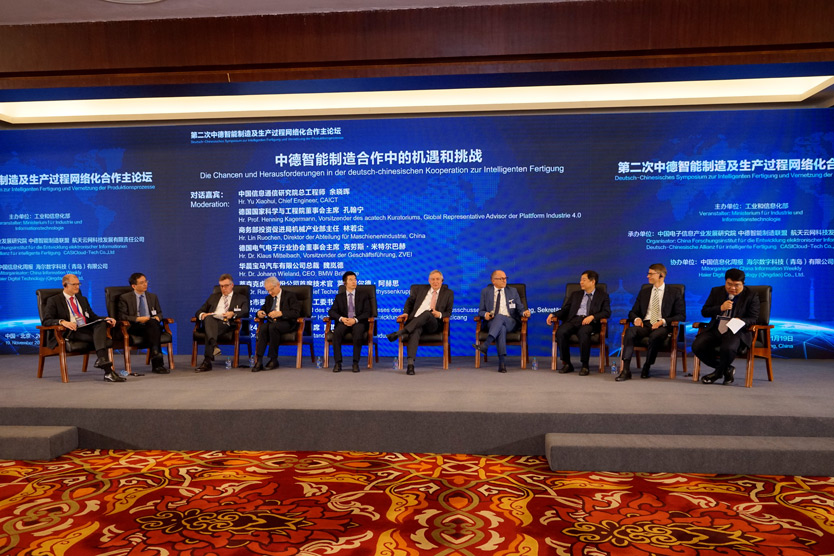
Moderators and participants of the panel discussion "The Opportunities and Challenges in German-Chinese Cooperation for Intelligent Manufacturing"
From 19 to 20 November 2018, the second annual meeting of the state secretaries and vice ministers on Intelligent Manufacturing and Interconnected Production Processes took place in Beijing, China. This year’s host was the Chinese Ministry of Industry and Information Technology (MIIT). The state secretaries Oliver Wittke from the Federal Ministry for Economic Affairs and Energy (BMWi) and Michael Meister from the Federal Ministry of Education and Research (BMBF) chaired the annual meeting with Vice Minister Dr Chen Zhaoxiong from MIIT and Vice Minister Zhang Jianguo from the Chinese Ministry of Science and Technology (MoST). Over 400 German and Chinese representatives from government, industry and science participated in the event.
The meeting took place on 19 November and was divided into a closed-door morning session with state secretaries, vice ministers and representatives from industry and science, and an afternoon session consisting of a Sino-German symposium on Intelligent Manufacturing and Interconnected Production Processes. On 20 November, around 80 German and Chinese company representatives took part in the Sino-German Working Group Industrie 4.0 and Intelligent Manufacturing (AGU). They discussed framework conditions for cybersecurity, IPR and artificial intelligence in China, as well as the new priorities of the industrial cooperation in 2019
As part of the closed-door session of the state secretaries and vice ministers, both sides reaffirmed their political will for long-term cooperation. The improvement of the framework conditions for German and Chinese companies for the implementation of Industrie 4.0 projects in both countries is a central task that both sides will continue to work on. The German side emphasised the need to further open Chinese markets, protect intellectual property, allow free and secure data traffic, and promote internationally harmonised standards. The Chinese side expressed interest in complementing the cooperation with relevant topics such as robotics and artificial intelligence.
In the subsequent symposium, the bilateral exchange continued with presentations of pilot projects and examples of innovative applications, as well as a panel discussion with high-level experts from both countries.
The panel discussion provided participants of the annual conference with deeper insights into the opportunities and challenges of Sino-German industrial cooperation. Jointly chaired by Thorsten Giehler, Country Director of GIZ in China, and Wang Peng, Vice President of the China Center for Information Industry Development, the experts identified key challenges in the bilateral cooperation, including cybersecurity and the need for adequate regulatory framework conditions. In his closing remarks, Prof Dr Kagermann, Global Representative and Advisor of the Plattform Industrie 4.0 and Chairman of the acatech Board of Trustees, highlighted the importance of mutual trust and reciprocity, which are crucial for a successful long-term cooperation, in addition to technical and regulatory aspects of the cooperation.
Germany and China have been cooperating on Industrie 4.0 in many ways:
In 2015, BMWi and MIIT agreed on cooperation on Industrie 4.0. The goal is to support cooperation projects between German and Chinese companies, and to improve the overall business environment. It has also been agreed that a high-level conference will take place alternately in Germany and China, which will also involve industry representatives.
Around two years ago, the BMBF decided to intensify German-Chinese research cooperation on Industie 4.0 and Smart Services. Four joint research collaborations were launched in 2018. The projects are based on the needs of German companies and will develop application-oriented solutions for economic implementation.
Since 1979, Germany and China have been cooperating in various commissions, including the German-Chinese Commission on Standardization, and, since 2015, in a sub-working group on standardization in Industrie 4.0. The aim is to jointly develop norms and standards as well as to strengthen cooperation in related organisations for international standards (particular IEC and ISO).
The cover photo shows the moderators and participants of the panel discussion "'The Opportunities and Challenges of Sino-German Cooperation in Intelligent Manufacturing": Thorsten Giehler, Country Director of GIZ in China; Wang Peng, Vice President of CCID; Prof Dr Henning Kagermann, Global Representative and Advisor of the Platform Industrie 4.0 and Chairman of the acatech Board of Trustees; Dr Klaus Mittelbach, CEO of ZVEI; Dr Jens Gayko, Managing Director of the Standardization Council Industrie 4.0; Lin Ruochen, Department Manager for Mechanical Engineering at the Investment Promotion Bureau of the Chinese Ministry of Commerce; Yu Xiaohui, Deputy General Director of CAICT; Dr Johann Wieland, President and CEO of BMW Brilliance Automotive Co. Ltd., and Wang Hongxing, Vice Mayor of Taicang City.
The German Federal Ministry for Economic Affairs and Energy has commissioned the Deutsche Gesellschaft ffs Internationale Zusammenarbeit (GIZ) with the implementation of the Sino-German cooperation on Intelligent Manufacturing by the Sino-German Industrie 4.0 Project as well as the Global Project Quality Infrastructure in the area of standardisation and norms.