Please support the Ministry’s public relations work: We need your consent to be able to measure your user activity on our website using etracker. A pseudonymised evaluation of this data by etracker helps us to improve our website. You can revoke your consent at any time for the future. Once you have made your selection, the consent management screen will appear at the bottom of the page. You can use this to stop or to reactivate the statistical evaluation at any point. You can reactivate tracking by dragging the slider in the opposite direction.
This website sets temporary session cookies. These are strictly necessary and therefore cannot be deselected. Their sole purpose is to enable you to use the website.
The Ministry also presents its work on this website in the form of videos. These are made available by the provider TV1 using JW Player. Please consent to the transmission of your IP address and other technical data to JW Player and allow JW Player to set cookies on your end device if you wish to view videos on our website. We also provide a consent management function for this at the bottom of the page. You can use this to control whether JW Player is enabled or not.
You can find detailed information on your rights and how we protect your privacy in our privacy policy.
Consent to the use of JW Player for video streaming
The Ministry also presents its work on this website in the form of videos. These are made available by the provider TV1 using JW Player. Please consent to the transmission of your IP address and other technical data to JW Player and allow JW Player to set cookies on your end device if you wish to view videos on our website. We also provide a consent management function for this at the bottom of the page. You can use this to control whether JW Player is enabled or not.
Report: International conference on cyber security in Industrie 4.0 brings together key players in Berlin
Introduction
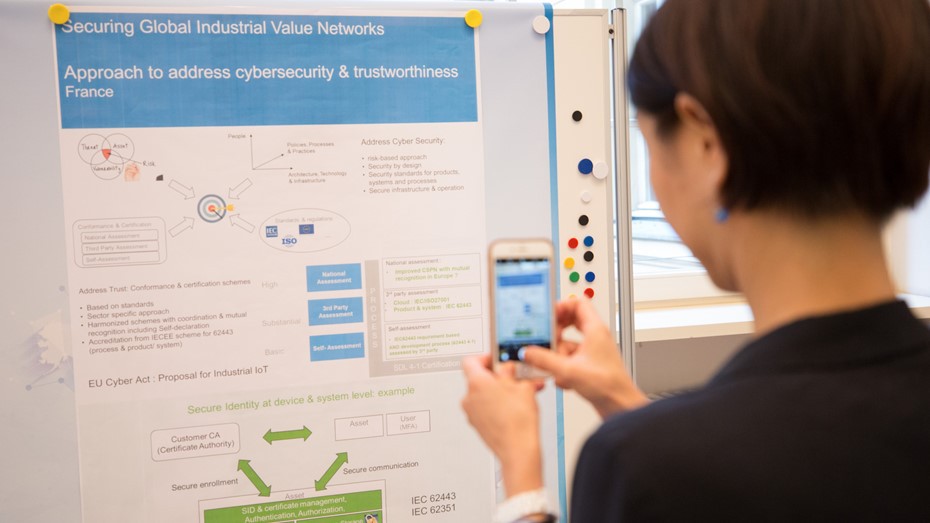
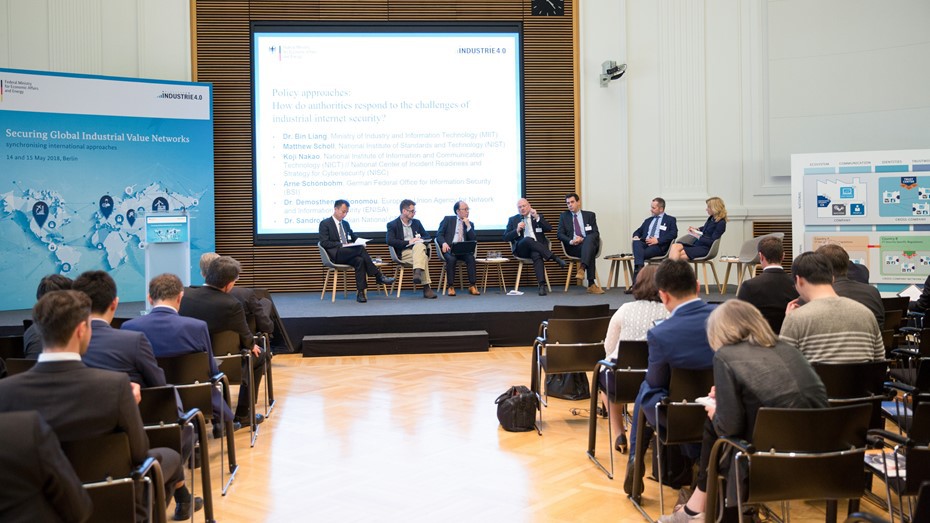
In mid-May, the German Federal Ministry for Economic Affairs and Energy and the Plattform Industrie 4.0 brought together around 140 international private sector and political decision-makers in Berlin. At the conference on “Securing Global Industrial Value Networks – Sychronizing International Approaches”, attendees discussed IT security in production processes from political, regulatory and technical perspectives. The contributions and debates revealed starting points for joint action with international partners.
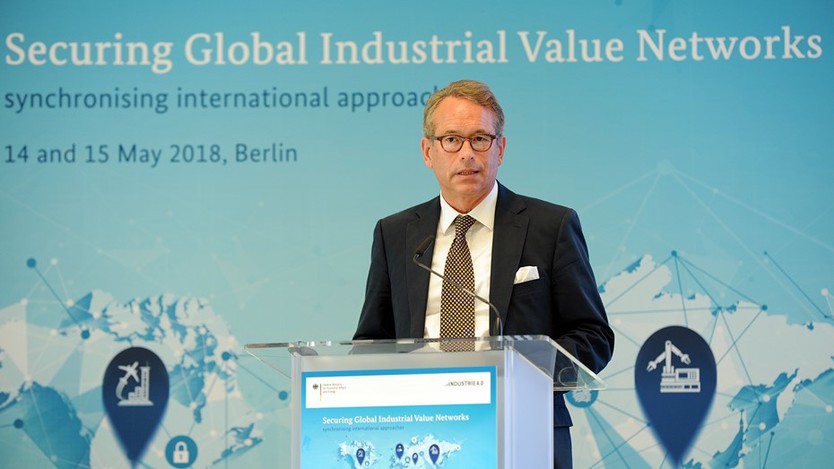
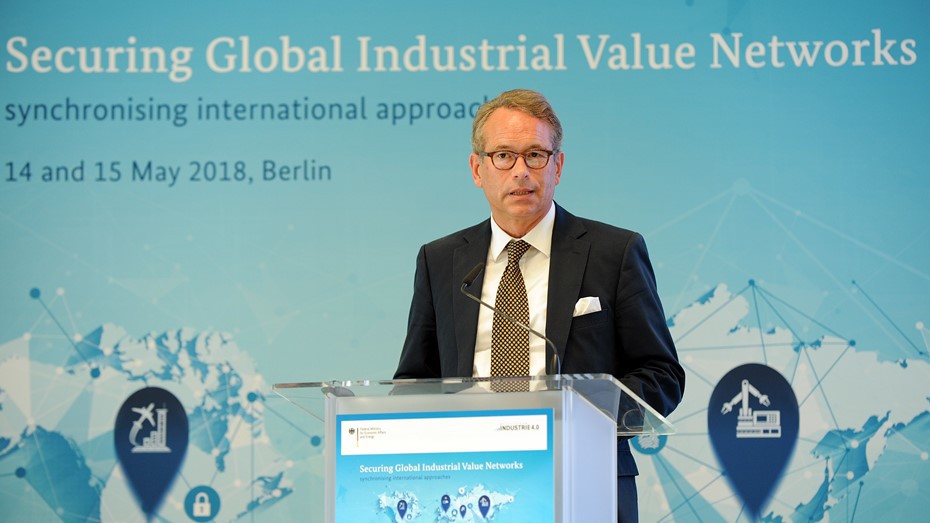
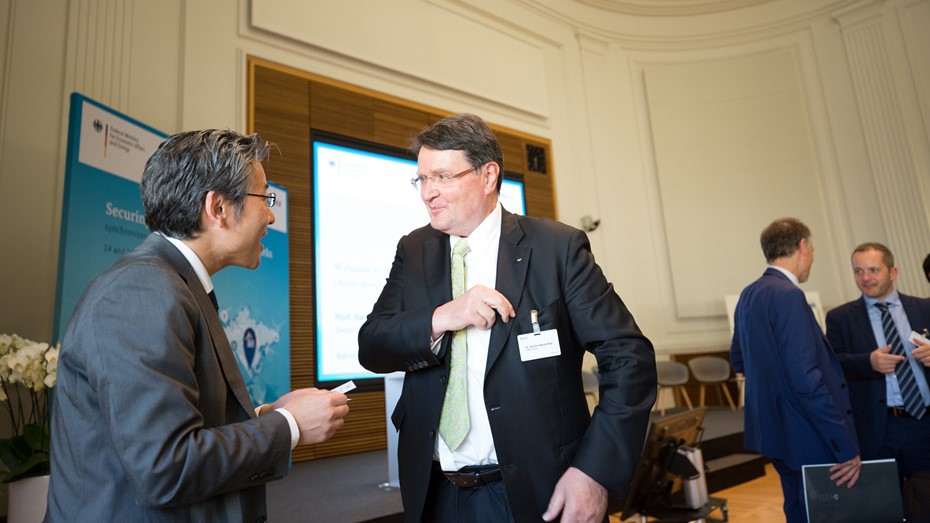
Together with the Plattform Industrie 4.0, the Federal Ministry for Economic Affairs and Energy (BMWi) invited international experts from the private sector, from ministries and from regulatory authorities to Berlin. Tension and conflicting priorities between various political frameworks was the focus of attention on the first day of the conference. The Secretary of State of the Federal Ministry of Economics, Dr. Ulrich Nussbaum, opened the conference with insights on framing conditions in Germany. High-level representatives from the European Union as well as ministries, regulators and industry initiatives from China, Germany, France, Italy, Japan and the United States outlined their approaches and identified areas for alignment.
On the second day, experts discussed various technical aspects of security over the course of four sessions. The exchange was structed around questions on (1) a cross-border security architecture for value networks, (2) conditions for secure communication and (3) secure identities and (4) the assessment of trustworthiness. The Plattform provided its concept papers in all four areas as a foundation for discussion (see article Four Challenges).
Results: IT Security - international interoperability of approaches
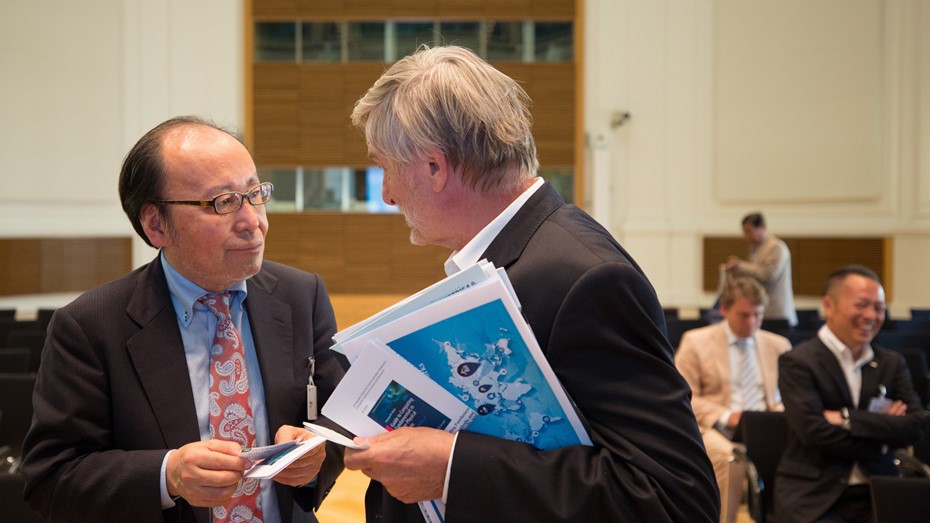
Contributions from Industry 4.0 organisations from China, Japan, USA, France and Italy provided an overview of various international perspectives and approaches from an industrial and political point-of-view. At the conference, it became clear that there is a will to develop common solutions: the presence of numerous government representatives, including representatives from Japan and China, highlighted the relevance of this question.
The content comparison on ideas for secure Industry 4.0 eco-systems, secure identities, secure communication and trustworthiness showed that these initiatives are not so far apart on several issues. The technical concept papers from the Plattform Industrie 4.0 were well received by the participants.
Christian Decker, CEO of DESMA GmbH, was a highlight of the conference: He presented his use case of "platform-based, order-driven production". This real-life example colourfully illustrated the security challenges of an internationally networked company for all participants.
Outlook: A first step of many
The participants agreed to, in follow-up of the conference, answer unanswered questions and develop ideas for technical and regulatory solutions. For example, they will work on jointly developing requirements for so-called "trust centers" (providers of "trusted services"), which will act as international anchors of trust in the future.
The working group "Security of Networked Systems" of the Plattform Industrie 4.0 will take up the findings from the conference in its continued work. It will work on formulating the obvious gaps and needs for new standards and frameworks and bring them to standardisation committees together with international partners.
Impressions of the conference
Konferenz “Securing Global Industrial Value Chains” in Berlin, Eröffnung von Dr. Ulrich Nussbaum, Staatssekretär im Bundeswirtschaftsministerium
Publication:Presentation of Michael Jochem, Robert Bosch: Panel 1
Security challenges along the industrial value chain – how to
harmonize national perspectives?
Publication:Presentation of Robert A. Martin, Industrial Internet Consortium: How can we achieve trustworthiness and integrity of data in industrial value chains?