Please support the Ministry’s public relations work: We need your consent to be able to measure your user activity on our website using etracker. A pseudonymised evaluation of this data by etracker helps us to improve our website. You can revoke your consent at any time for the future. Once you have made your selection, the consent management screen will appear at the bottom of the page. You can use this to stop or to reactivate the statistical evaluation at any point. You can reactivate tracking by dragging the slider in the opposite direction.
This website sets temporary session cookies. These are strictly necessary and therefore cannot be deselected. Their sole purpose is to enable you to use the website.
The Ministry also presents its work on this website in the form of videos. These are made available by the provider TV1 using JW Player. Please consent to the transmission of your IP address and other technical data to JW Player and allow JW Player to set cookies on your end device if you wish to view videos on our website. We also provide a consent management function for this at the bottom of the page. You can use this to control whether JW Player is enabled or not.
You can find detailed information on your rights and how we protect your privacy in our privacy policy.
Consent to the use of JW Player for video streaming
The Ministry also presents its work on this website in the form of videos. These are made available by the provider TV1 using JW Player. Please consent to the transmission of your IP address and other technical data to JW Player and allow JW Player to set cookies on your end device if you wish to view videos on our website. We also provide a consent management function for this at the bottom of the page. You can use this to control whether JW Player is enabled or not.
Pan-European cooperation on Industrie 4.0 standardisation
Introduction
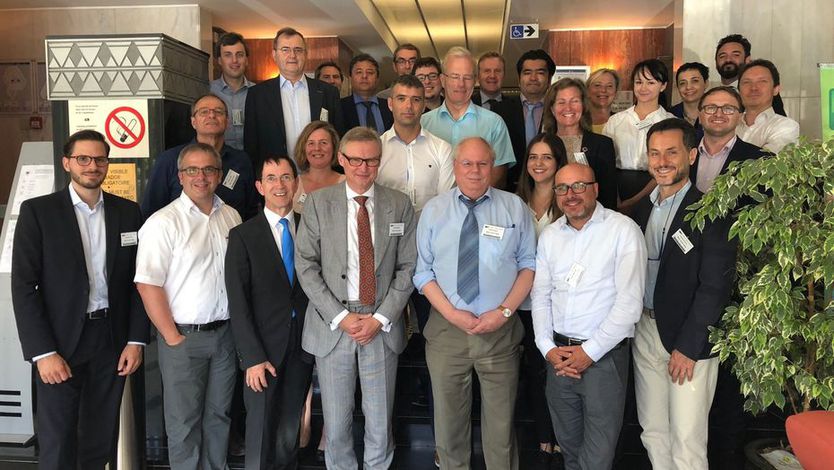
Through the initiative of the European Commission and the trilateral cooperation, 30 experts from all over Europe met in Brussels on July 2nd 2018. The goal: to establish Pan-European cooperation in Smart Manufacturing standards. The participants were motivated to work together to promote "Smart Manufacturing Made in Europe". A follow-up workshop in Brussels was arranged for the end of 2018.
Brussels, July 2nd, 2018 | The trilateral cooperation between Germany, France and Italy was established in the summer of 2017. The liaison between Plattform Industrie 4.0, Alliance Industrie du Futur and Piano Industria 4.0 moved fast. National approaches towards standardisation were streamlined to install international standards. At Hannover Messe 2018 the trilateral publication “structure of the administration shell” substantiated a broader European discussion.
The trilateral cooperation aims to drive the European standardisation debate forward and to foster a thorough exchange with other European countries (see also activities of the Digitising European Industry initiative by the European Commission) and with international standardisation bodies. With this aim, a workshop has been organised on July 2nd in Brussels, contacting members of the Joint Working Group 21, “Smart Manufacturing Reference Model(s)”, that links IEC/TC 65 and ISO/TC 184. Experts from several European countries (Belgium, Netherlands, Norway, Austria, Poland, Czech-Republic, Sweden, Spain) took part in the technical discussions of the trilateral cooperation for the first time and debated the administration shell in-depth. The outlook on the trilateral roadmap and the close interlocking with the European multi-stakeholder platform were part of the session as well.
Current results of the trilateral cooperation on the administration shell were welcomed and a validation of present results through participating European countries until end of 2018 was agreed upon. The possibility of setting up a European coordination group is being discussed in the MSP/DEI working group, in order to ensure that European positions are constantly heard at international level.
Created in July 2015, Alliance Industrie du Futur brings together professional organizations from industry and digital technology along with academic and technological partners, all rallying around a common ambition: to make France a leader in the world’s industrial renewal. Alliance Industrie du Futur is tasked with putting into practice the National Industry of the Future project launched by the French Government in April 2015, in the framework of the organizational overhaul of the New Face of Industry in France. Alliance Industrie du Futur has a particular mandate to support companies, especially SMEs, in the transformation of their business models, their organization, and their design and marketing methods, in a world in which new tools based, for example, on the digital, on additive manufacturing, on new materials and on advanced robotics are bringing down the barriers between industry and services. Website
About the Plattform Industrie 4.0
Plattform Industrie 4.0 is the central network in Germany to advance digital transformation towards Industrie 4.0. In close cooperation with politics, industry, science, business associations and trade unions, over 350 stakeholders from almost 160 organisations are actively involved in the platform. The platform develops and coordinates information and networking services to raise awareness on Industrie 4.0 solutions among companies and to deploy them on-site. As one of the largest international and national networks, it supports German companies—particularly medium-sized companies—in implementing Industrie 4.0. It provides companies with decisive impulses through examples of company best-practices from across Germany, as well as concrete recommendations for action and test environments. The platform’s numerous international co-operations underscore its leading role in international discussions on Industrie 4.0. Website
About Piano Industria 4.0
In order to boost productivity and accelerate technological upgrading the National plan “Industria 4.0” of the Italian Government is focusing on strategic measures to support innovative investments and empower skills, such as: Super and Hyper amortization schemes, tax credits on R&D and on profits from intangible and patented assets, strengthening of vocational training, creation of I4.0 Technological Clusters and Industrial PhDs. Moreover, complementary measures being implemented are the establishment of Competence Centers and of a network of Digital Innovation Hubs, Ultra Broadband with a fiber to the factory approach, cooperation on IoT open standards and interoperability, easier access to financing and productivity salary taxation exchange. Website